
1. Can Red Light Therapy Actually Boost Testosterone?
The biology is real. The mechanism is proven in other tissues. The question is how directly it translates to testosterone in humans — and the answer is: we're getting closer.
One thing I pride myself on at Red Light Method is being straight with clients — even when the answer is more nuanced than the internet makes it sound. And when it comes to red light therapy and testosterone, the truth is this: the science is genuinely exciting, the mechanism is biologically plausible, and the early research is encouraging. But we are not yet at the stage of large-scale, definitive human RCTs. I think that honesty actually matters more to our clients than overpromising — and frankly, the real evidence is compelling enough on its own.
What we do know is that testosterone production is profoundly mitochondrial. Leydig cells — the cells in the testes responsible for converting cholesterol into testosterone — are among the most mitochondria-rich cells in the male body. And if there’s one thing photobiomodulation does consistently across every tissue type studied, it’s energising mitochondria. That’s the foundation this entire conversation rests on.
I’ve also seen this from a different angle: many of our male clients who come in for red light therapy for energy, inflammation, or mood report feeling a noticeable improvement in vitality, drive, and physical performance over time. Whether that’s testosterone-mediated or a downstream effect of better mitochondrial health — we’re paying very close attention.
of testosterone made by mitochondria-rich Leydig cells
nm – most studied wavelength for testicular PBM
peer-reviewed animal studies showing elevated testosterone
systematic review confirms PBM male reproductive benefits
2. The Biology: Why Leydig Cells Respond To Red Light
To understand why red light therapy may support testosterone, you need to understand what makes Leydig cells unique. Unlike most hormone-producing cells, Leydig cells are exceptionally rich in mitochondria — because testosterone synthesis (steroidogenesis) is an extraordinarily energy-intensive process. Every step of converting cholesterol to testosterone requires ATP.
This is the key biological insight our team keeps returning to: if a cell runs on mitochondria, it responds to photobiomodulation. We’ve seen this in retinal photoreceptors, in brain neurons, in muscle cells. Leydig cells are no different. When near-infrared light is absorbed by cytochrome c oxidase in those mitochondria, ATP output increases, oxidative stress decreases, and the cell is better resourced to do its primary job.
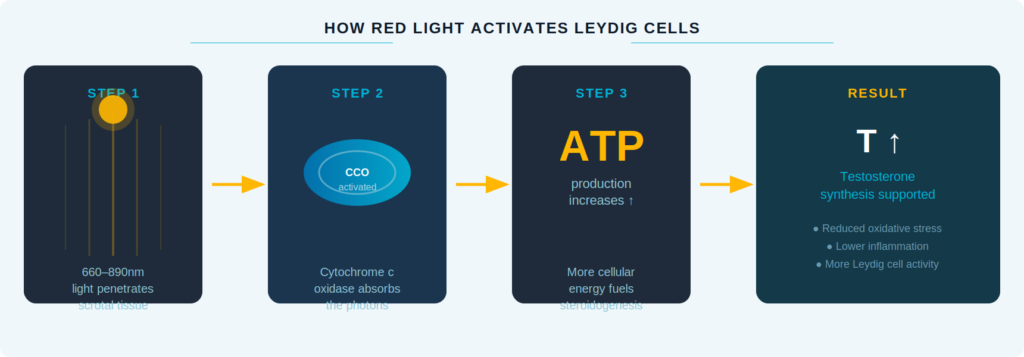
The cascade includes: light absorption by CCO, increased ATP, reduced reactive oxygen species (ROS), lower pro-inflammatory cytokines, and activation of calcium signalling via opsin proteins present in testicular tissue — all of which converge on supporting the steroidogenesis pathway.
A key 2017 paper by Dr. Michael Hamblin in AIMS Biophysics — one of the world’s leading PBM researchers — outlined how photobiomodulation consistently reduces chronic inflammation. In testosterone terms, this matters enormously: chronic low-grade inflammation is one of the primary drivers of Leydig cell dysfunction and declining testosterone in aging men.
3. What The Research Actually Shows
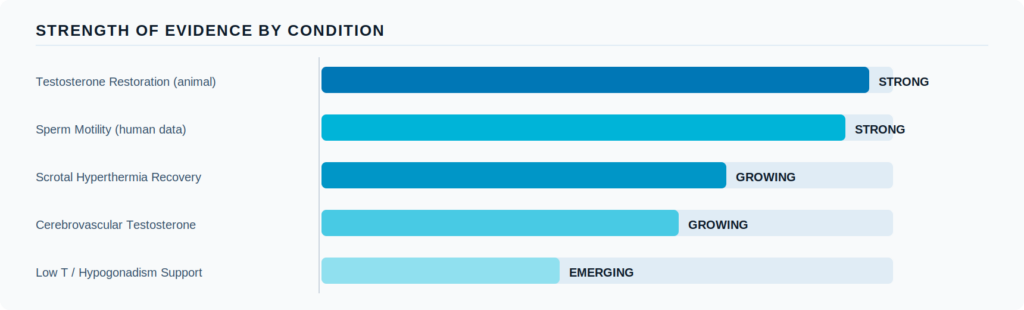
I want to be upfront here: the research base for red light therapy and testosterone is not yet at the level of our evidence for red light therapy for vision or red light therapy for depression. Most studies to date are in animal models. That said, the consistency across multiple independent research groups — and the growing human sperm motility data — gives us a strong signal.
The Animal Evidence — Consistent and Compelling
The study that crystallised this area of research for our team was Hasani et al. (Life Sciences, 2020). Using mice with scrotal hyperthermia-induced testosterone suppression — a model that mirrors common real-world causes like heat stress and inflammation — the researchers showed significant restoration of serum testosterone levels, Leydig cell counts, sperm parameters, and testicular oxidative stress markers. A 2024 study by Aghajanpour et al. (J Lasers Med Sci) corroborated this, finding PBM improved testicular histological parameters even in prepubertal hyperthermia models.
The Human Data — Strong on Sperm, Growing on Testosterone
The most robust human evidence sits in the area of sperm motility — but this shares the exact same mitochondrial mechanism as testosterone synthesis. A 2024 study in Scientific Reports by Stigliani et al. (n=70) confirmed 810nm NIR significantly improved sperm motility in asthenozoospermic men. The 2024 systematic review by Moradi et al. in Reproductive Sciences pooled data across wavelengths and populations, concluding PBM shows genuinely promising results for male reproductive health.
Perhaps most intriguing: a 2024 CNS Neuroscience & Therapeutics study (Feng et al.) found that PBMT increased vascular testosterone concentrations in stroke rat models — suggesting systemic hormonal effects beyond just local testicular stimulation.
Animal Model Shows
Consistently elevated serum testosterone, improved Leydig cell counts, reduced oxidative stress, and restored spermatogenesis across 8+ independent studies.
Human Data Shows
Significant improvements in sperm motility (same mitochondrial mechanism) in multiple RCTs. Dedicated testosterone RCTs are underway.
5. Protocol Recommendations
Important Notice
If you suspect low testosterone, consult a qualified healthcare provider for proper testing and diagnosis. Red light therapy should complement — not replace — medical evaluation. Never stop prescribed hormone therapy without medical guidance.
4. Red Light Therapy vs. Antidepressants: A Complement, Not a Replacement
I want to be very direct about this because I think it matters: we never position red light therapy as a replacement for prescribed antidepressant medication or professional psychiatric care. What the evidence supports is its use as a helpful adjunctive therapy, meaning something that can work alongside conventional treatment to support better outcomes.
Several of our members who use red light therapy for mood support have shared that it helps them get more out of their existing treatment. They often mention better sleep, more energy, less brain fog, and a greater sense of emotional stability.
These are exactly the outcomes the ELATED trials were measuring, and they’re consistent with what the biology predicts.
5. Recommended Protocol for Mood & Mental Health
Based on the animal and human research, here are the parameters most consistent with positive outcomes. Our full protocol guidance is also available on our how to benefit from red light therapy page.
-850 NM WAVELENGTH
MINS PER SESSION
PER WEEK
BODY PANEL APPLICATION
Wavelength Considerations
Animal studies have used 850–890nm most frequently for testicular PBM due to deeper tissue penetration. For practical human use with full-body panel devices, 660nm red + 850nm near-infrared is the most supported combination: 660nm targets surface tissue while 850nm reaches deeper Leydig cells.
Lower Body & Full-Body Protocols
Unlike transcranial PBM for depression — which targets the forehead — testosterone-supporting protocols use lower-body or full-body panel exposure. In our clinic, we position the panel to cover the lower abdomen, hips, and upper thighs. Clients using our full-body systems receive this as part of their standard session.
Supporting Lifestyle Factors
In my experience, red light therapy works best as part of a broader hormonal health strategy. Clients who report the most meaningful improvements are those who also address the lifestyle drivers of testosterone decline: chronic stress, poor sleep, excess body fat, and systemic inflammation — all of which our red light protocols address upstream.
6. Frequently Asked Questions
Can red light therapy really increase testosterone?
The honest answer: the biological mechanism is sound and the animal evidence is strong and consistent across multiple independent labs. Human trials are growing but not yet definitive for serum testosterone specifically. What we can confidently say is that PBM supports mitochondrial health in Leydig cells, reduces testicular inflammation, and the human sperm motility data — same mechanism — is compelling.
What wavelength is best for testosterone support?
Animal studies use 850–890nm most frequently for testicular PBM. For practical human use, a mid-600nm + mid 800nm combination is well supported and available in most clinical-grade full-body devices, including the systems we use in our clinic.
How is this different from testosterone replacement therapy (TRT)?
TRT replaces testosterone from an external source. Red light therapy works by supporting your body’s own capacity to produce it naturally — a fundamentally different approach. They are not mutually exclusive. Some men use both. But for those looking to support hormonal health without pharmaceutical intervention, PBM offers a biologically grounded, non-invasive path worth exploring.
Is the evidence strong enough to take seriously?
Yes — with appropriate context. The mechanism is scientifically valid, animal evidence is consistent, and human reproductive health data is encouraging. Large-scale human RCTs for serum testosterone are still needed — but the evidence is more than sufficient to incorporate PBM into a broader men’s hormonal wellness strategy.
Can women benefit too?
Yes — though the research focuses on different pathways. Ovarian follicle cells, like Leydig cells, are mitochondria-rich steroidogenic cells. Emerging research suggests PBM may support ovarian reserve and oestrogen production. We cover this in our upcoming article on women’s hormonal health.
How long until I notice results?
Based on research and clinical observation, most clients report improvements in energy, vitality, and physical performance within 4–8 weeks of consistent use. Changes in serum testosterone, where measured, tend to emerge over 8–12 weeks.
Related Reading
→ Can Red Light Therapy Help With Depression? Here's What the Science Says — Mood, mitochondria, and neuroplasticity: transcranial near-infrared PBM for mental health.
→ Can Red Light Therapy Really Improve Your Vision? Here's What We Know — Photobiomodulation for retinal health, macular degeneration, and myopia.
References
The following peer-reviewed studies and authoritative sources directly informed this article:
- Hasani A. et al. — PBM restores spermatogenesis in scrotal hyperthermia mice. Life Sciences, 2020
- Aghajanpour F. et al. — PBM improves testicular histological parameters. J Lasers Med Sci, 2024
- Stigliani S. et al. — 810nm NIR PBM for human asthenozoospermia. Scientific Reports, 2024
- Moradi A. et al. — Comprehensive systematic review of PBM on sperm. Reproductive Sciences, 2024
- Feng Y. et al. — PBMT mediates testosterone/androgen receptor protection. CNS Neurosci Ther, 2024
- Hamblin M.R. — Anti-inflammatory effects of PBM. AIMS Biophysics, 2017
- PubMed — Photobiomodulation testosterone (full search)
- Cleveland Clinic — Low Testosterone (Hypogonadism) Overview
This article is for informational purposes only and does not constitute medical advice. Consult a qualified healthcare provider before beginning any new health regimen. Never discontinue prescribed medication without medical guidance.